
It started with a failure
I was a third-year Natural Sciences student at Trinity when I found myself gazing across the vast desert from the Thrust SSC mural in Gerlach, Nevada. I knew I was also utterly mad. Where much greater men than I had smashed the sound barrier, I had spent weeks working to double that, but vertically, with a rocket.
It all started with a failure. My very first rocket, as lead and chief designer of our school rocketry team, failed spectacularly. Or rather, about half a second after it left the pad, it suddenly decided, “When I grow up, I want to be a sea-skimming missile!” And it did, disappearing out over the lough we were beside, and leaving us to tread the shores disappointedly in the hope of spotting any recoverable parts.
It was a long drive home. Of deep disappointment, of mentally checking every assumption, every estimate, every decision. Working through every possible outcome. Even two years and a dozen successful flights later, I still didn’t have the slightest clue why. It might well remain one of life’s great mysteries.
But I was determined not to let that define my rocketry. So I launched into a campaign to improve and refine my designs, and learn as much as I could from other rocketeers, the infinite internet and, of course, the Trinity library, which has taught me more about aerodynamics and control surfaces than all else put together! And I built a lot of rockets. And I had a lot of failures…
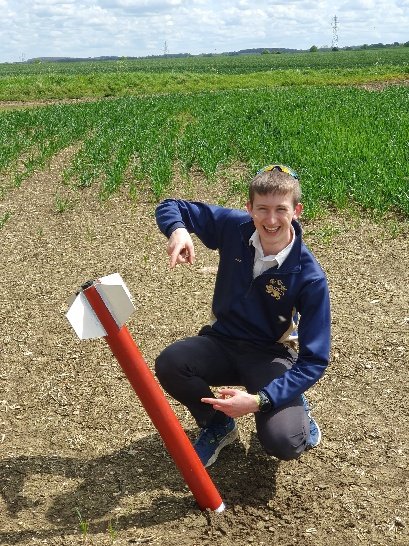
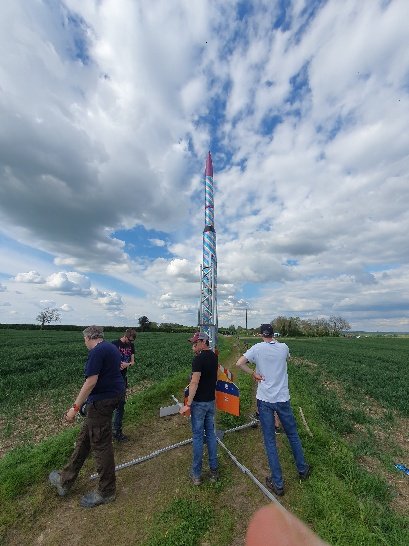
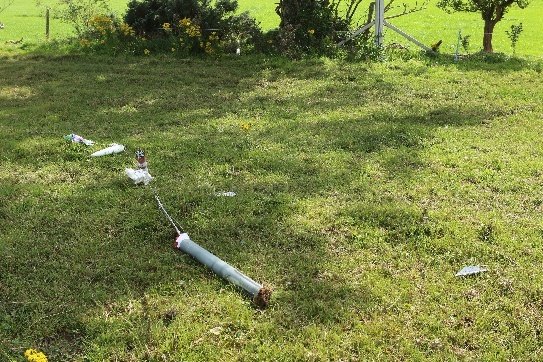
The research and experimentation did eventually pay off. A small team of us launched a campaign to fly a display rocket at an airshow and, after many long nights in the workshop, pulled off a textbook flight.
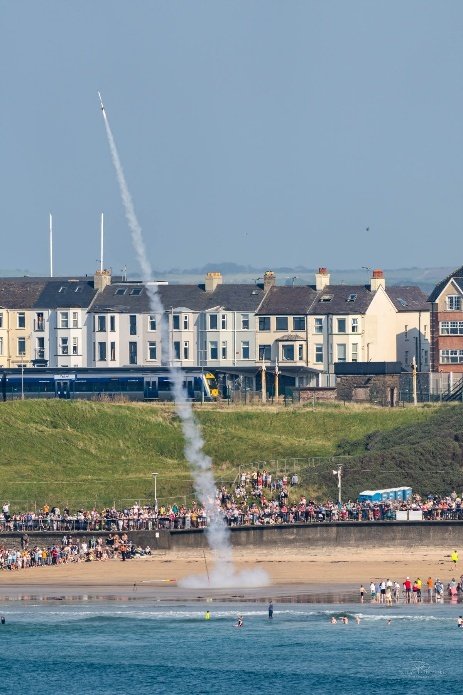
So now I could fly rockets. What next?! I needed a new boundary to shatter, and I found that in the all-out competitions in high-performance rocketry. Pushing the absolute maximum to get the highest altitude and speed from each class of rocket motors requires not only a good design, but also painstaking care in building and assembling the rocket so that everything works exactly as planned.
Armed with a grant from Trinity’s Projects Fund, I headed west with destiny. Twenty-six hours of travel later, I had arrived. And there I was, gazing out in a vain effort to see the white streak of a rocket trail that would let me know my final destination.
Black Rock Desert
There is barely a more beautiful sunrise than over the flat desert, with a horizon studded with great mountains. Nor a more uncomfortable position to watch it from than struggling to revive some form of blood circulation in your legs after sleeping in the boot of a car…
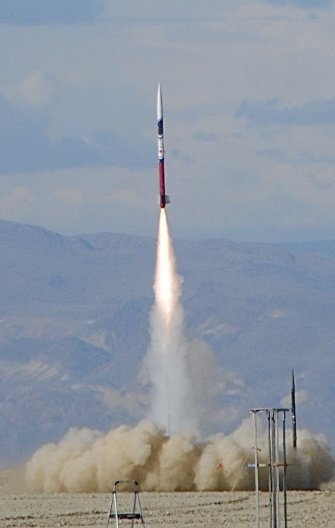
I was right in the thick of it. We had only nine hours before the airspace waiver closed. We collected the rocket motors from a dealer, and I began to reassemble the electronics. For my planned flight to 6,000 metres, I was relying on a live tracking link. And when I plugged in the ground station, the greatest fear of all electricians was realised.
I unleashed the magic smoke. That unknown element within circuit-board components, without which all fails, drifted away across the playa from my radio module. I might as well have been on the moon for all the information I could now downlink from the rocket. Without that link I couldn’t launch: my entire ability to recover a rocket that could drift for miles was based on having the GPS coordinates relayed back in real time.
Sometimes you just don’t know what to do. So I trekked back to the car to once again attempt to hydrate under the burning sun, and enjoyed the chance to chat to people along the way, both those who had watched through the weekend and those who had come with much more ambitious projects than mine.
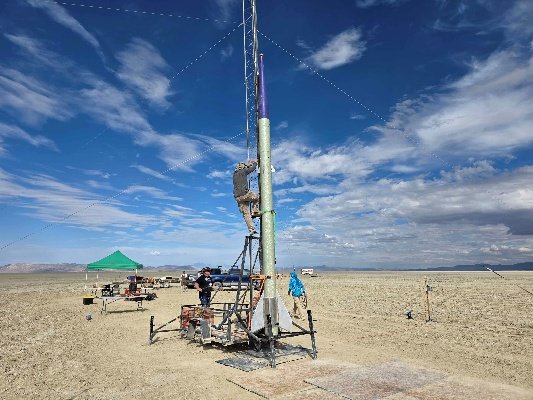
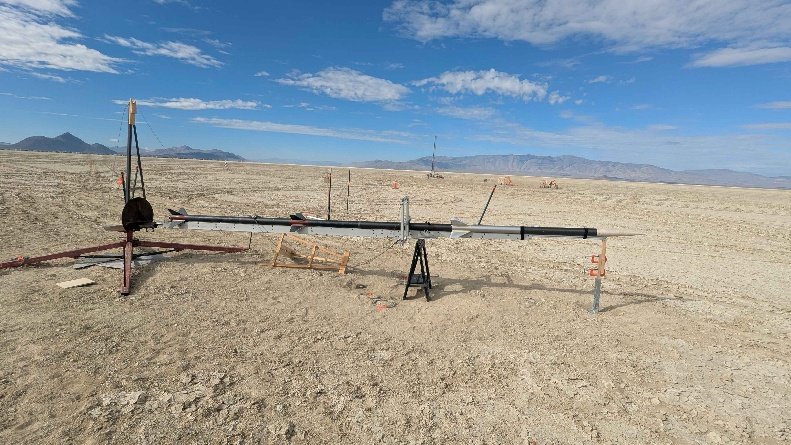
Some of the largest rockets ever flown; three-stage behemoths, including vertical-orientation systems designed to maintain the rocket’s attitude throughout the flight; experimental rocket motors. Many of the projects here were pushing the boundaries of what is not only practically possible, but also theoretically possible.
This is one of the greatest things about going to international launches: not only the priceless opportunity to launch your own projects, but also to learn from research and development done elsewhere.
The repair
Then I tracked down a possible replacement for my faulty flight computer. Armed with a similar flight computer, similar enough to also have a failed Wi-Fi module for programming the board, I went back to the dashboard of the car and set up for a long afternoon.
A lab is an excellent place to learn surface-mount soldering: a controlled, clean environment, support available and a range of tools. The sand-permeated dashboard of a hire car, in a signal-blackout area of the desert, with only an inch of solder flux and a battery-powered soldering iron? Not so much.
But somehow I had a flight computer, bleeping and transmitting happily. Not only transmitting, but sending sensible, coherent messages back to a receiver.
With barely 30 minutes until the launch window closed, I sprinted to collect the appropriate equipment and set to the quickest assembly I could safely do. Parachutes packed, with ejection charges for deployment? Flight computer secured so it wouldn’t shake loose during flight? Nose cone secured, with the vent holes for measuring atmospheric pressure clear? Parachute attachment points secured?
Somehow, with bare minutes left, all was prepared. I walked out towards the launch tower, my heart shaking like a tambourine. I had made it, and we would at least manage to launch. I would know if my design was sufficient for the task at hand.
The countdown
I stood just over 100 metres away as the countdown moved down to zero.
3,
2,
1,
Launch.
I saw a minute puff of grey smoke at the bottom of the pad.
And waited.
Nothing.
The launch director broke my reverie as he called a misfire of the rocket motor. It had failed to light. With the closure of the waiver impending in minutes, that ended the possibility of launching.
What comes next
I packed up and left that night exhausted. It hadn’t exactly been a success in many ways, but the lessons I had learnt were invaluable and the experience had been transformative.
My journey in rocketry had by no means ended. The wall of my garage at home, already festooned with pieces of past rockets, now bore a motley collection of pieces of paper. To the uninitiated, the diagrams and scribbled equations showed little. But they held the plans for a future attempt: not only to reach towards the skies again, but to claim the record I had set out to obtain. And a few others besides…
With thanks
To Trinity’s Projects Fund for the grant that supported the trip.